Welcome to my digital bedroom.
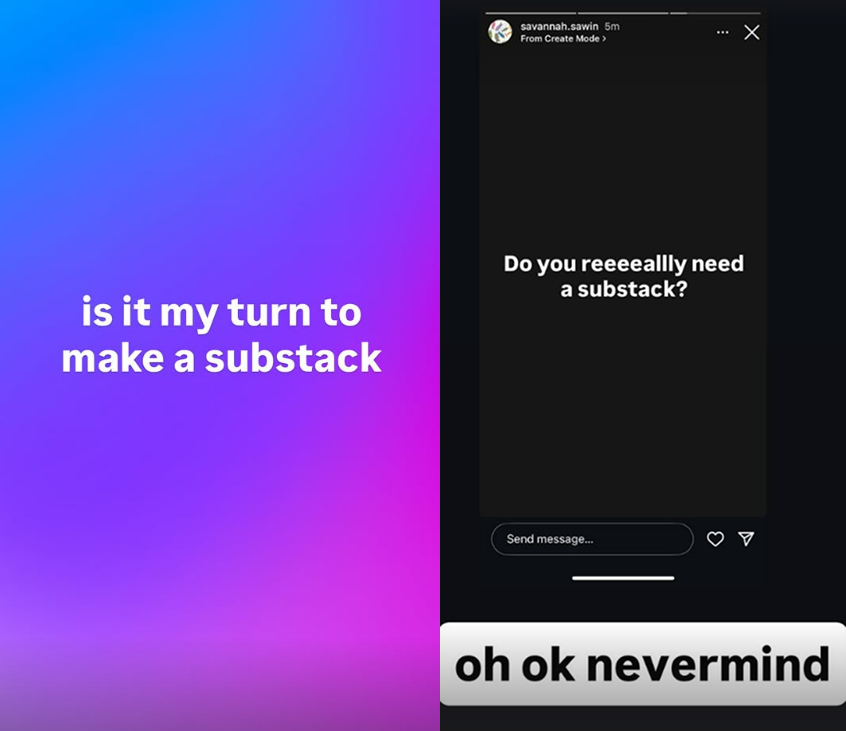
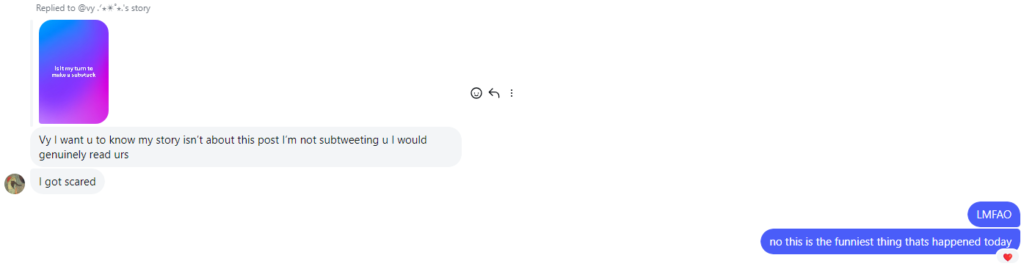
This was a question apparently not directed at me, but made me reconsider nonetheless.
I’ve been wanting to really get back into writing. It’s something that I’ve begun to put off ever since I graduated high school. Technically, I never stopped. In college, I took five writing courses for my Creative Writing Minor, but writing for those classes was inherently different from what I used to do.
I’ve been writing since I figured out how to, and I began posting my writing online when in middle school. I was a fan-fiction author on Wattpad and around the same time, I was posting short journal entries to an anonymous tumblr blog. I had hundreds of thousands of reads on Wattpad at my peak, but at some point, I stopped. Writing on Wattpad became too embarrassing. I began dreaming of more serious, longer-term projects such as novels and comic books. None of these ever became completed, and none of them ever saw the light of publication. In college, I began writing poetry and short stories to be published in literary magazines. These pieces have to be submitted during a submissions window, and then read and analyzed by a group of faceless editors who decide whether or not your piece will make the cut.
I used to write every single day; essays and diary entries, stories, and poems that weren’t for anyone except me. I didn’t even have to try to write, it was as if I could not help myself but write. Nowadays, I get an urge to write every few weeks, and I only ever act on the urge once in a blue moon. I used to blame the lack of writing on a shortened attention span, and a loss of imagination. A better answer is that my standards for writing have gone up– writing with intent to be published and taken seriously by a literary community is inherently different from writing for yourself. I no longer felt keen to write if my intentions were not to create something worthy of submitting to be published by someone who was not myself. So I have not stopped writing, but I’ve stopped writing as a practice. In pondering why I have stopped writing for self publication, I’ve come to realize that the internet has changed since I stopped writing.
I considered trying out Substack. There have been a number of publishing platforms for writing that have popped up. Substack is the most popular one, but others like Ghost and Medium are popping up. On Substack, anyone can publish their thoughts and opinions, including pop artists like Charli XCX and Doechii, but also anyone with a phone or computer. This includes your annoying college roommate, your ex-boyfriend with bad takes, and your coworker who trauma dumps in the break room.
Do you really need a Substack? The implication of that question is that with modern self-publishing platforms, there is an inherent humiliation to it– that you yourself have deemed your work worthy of being read by someone who has no connection to you. It carries the implication that you believe your thoughts are grand and interesting enough to be shown on someone else’s feed. We now think of social media, and publishing platforms that operate similarly to social media, as public spaces. To say something on X, or to publish your thoughts on Substack, is equivalent to nailing your thesis in the public square. Those who do not know you, who do not specifically consent to hearing from you, can see your work due to its use of algorithms, but also the inherent nature of posting something you made to a larger platform. What you publish is not just writing, it is content. It exists to fill up a bigger space.
My mom had a blog in the 2000s to 2010s. It was her public journal where she would write about her day to day life as a single mother watching her children grow up, her poetry, and photos of her arrangements as a floral arranging hobbyist. I remember how she’d wake up an hour or two before work to write on her computer while we slept, because it was the only time she had to herself. We had one of those huge, boxy, tan computers and a loud, clacky keyboard. She wrote only in Vietnamese and she would tell me that I would have to learn to read Vietnamese so that one day, I could read her blog when I was older. I really believe that writing her blog was her way out of feeling helpless and overwhelmed by her life. She had something of her own that she was proud of, and she felt seen and understood through it, especially as an immigrant in a country that often did not understand her or her struggles. At some point, she let her domain name expire and stopped writing. I now can only access her writing through the Wayback machine. Her website, like many others, has become an internet artifact.
I feel a lot of envy for those who were on the internet in its earlier days. I feel as though I missed out when personal websites ruled the internet, when tumblr was in its peak, and when mySpace was popular. The web was a playground for self-expression and customization. Everyone learned bits of HTML from each other, and every website looked a little different. As a designer and as a writer, I feel quite sad, like I lost my chance at participating in that stage of the internet. It was not embarrassing to write or do whatever you wanted on your own site, to take ownership of it, and have it be ugly, messy, or unprofessional.
We’ve lost a lot of ownership of the internet in a very short amount of time. The internet was and is a technology so revolutionary and impactful, the only thing close to it was when the printing press was introduced. And just within a few years, its landscape and how it’s used has changed so much. By the time I was old enough to use the internet, every kid already had a smartphone, and the existence of social media platforms was already firmly established, with personal sites phasing out. But even then, there was still a sense of personal ownership. For example, Instagram was once a platform for sharing photos to friends and family. Your feed was organized chronologically and who your posts were shown to were mostly people you knew. So you posted accordingly– photos of what you had for lunch that day, pictures of your friends jumping into the lake, and pictures of your dog. Now, all of Instagram, not just its explore page, is organized algorithmically to prioritize content creators, to provide you with an endless feed of entertainment, not connection. Many people still post their personal moments, but often with the understanding that their personal moment is content for someone else to view, that it has to say something about their online image. Even less people open Instagram with the intention to view personal moments. That’s no longer it’s main purpose. Your profile is no longer your personal album of moments, but content created to draw attention. Now your home feed will algorithmically show you suggested content from people you don’t even follow. Most social media platforms went in this direction, and now most of Gen Z won’t remember a time where the internet was used for anything other than content.
Tumblr was one platform that didn’t really follow suit. I always wished I was born a little earlier to really enjoy the early 2010s tumblr craze as a teenager. By the time I ever made a tumblr, it was already considered to be dying in popularity. But tumblr, for a very long time, held close to chronological feeds, only showing you posts from people you followed. It was a blogging site, which gave you the feeling of ownership over your personal blog, while being able to follow and interact with other blogs and users like a social media site. God, why did we ever let that die? It was so fun. The number of followers you had never mattered, how you looked or what you were selling didn’t matter either. It mostly just mattered how weird and obsessed with whatever you blogged about you were. It was hard for Tumblr to make money, and ownership of the platform changed hands multiple times, with each swap causing more users to leave. Of course, there are still loyal people who still use tumblr, but it’s not what it used to be.
All this to say, we forgot how fun it is to have spaces of our own, and to find connection and share ideas without the whims and agendas of whatever platform we used. It’s not really our fault. The internet has been cut up and taken by corporations, and websites are just seen as storefronts for businesses and companies, not spaces for individuals or communities. Because of this, websites and apps mostly look the same now.
I realize that I wrote so much as a teenager because I was a teenager. It was a special in-between stage where I had all the time in the world, and I was alone for a lot of it. I wanted a safe place for my thoughts, feelings, and ideas to exist in the world, more than I wanted to actually say any of it or have it be heard. When you’re fourteen, having your own space in the world felt like the only thing that mattered. I laid in my bedroom until 2 or 3 in the morning just to write. I feel like I was the happiest with my work then, and not because it was good.
If publishing platforms are public spaces, what I need to start writing again is a room of my own.
There’s still a lot of opportunity in web to do whatever I want, to write however I feel, and to make what I want. There’s a small, but strong community of people still interested in creating a free, open source internet. There are still bloggers, artists, developers, writers, and creators who still see potential in the internet, and code, as a medium for creativity, connection, and meaning. Inspired by them, I’ve been trying to learn HTML/CSS to get a basic understanding on how the things I design actually take shape on a website. It’s been strangely rewarding, but I admit that I’m not very good at it. I mostly have been learning through trial and error, and with the help of my friend Cody, and my other friend, YouTube.
I wanted to learn enough code to at least begin dreaming of creative projects I could do with web, and how I could begin combining it with my love of writing. I started this with the belief and hope that learning at least the basics of code myself would give me access to more creative ownership and freedom, as a designer and as a writer. Cody and I made a poem generator as my first project. It’s just a simple generator that randomizes three lines of writing to create one full sentence. I added this as a fun addition to my design portfolio, but I wanted more ambition.
I liked making my design portfolio, but I used a website builder in order to create it. This was the most ideal way to do it, since I wanted my portfolio to speak for my design skills and instincts, while still looking professional. But I wanted to create a website for just myself, that wasn’t to advertise anything. Just a space for me to play and write. I thought it a good excuse to learn more about WordPress, since it is still the most popular CMS, and what my mom had used to make her blog years ago. I decided to try to style it from the ground up, without using a pre-designed theme or a “drag and drop” website building plug in. Instead, I used Blankslate, a complete skeleton theme and challenged myself to figure out the HTML and CSS required to make it my own.
It’s been an interesting design challenge. Most websites look the same because that layout works, and uniformity is an easy way to look “legitimate.” Designing just using lines of code kind of made me feel like I was building a house with just sticks and mud, and I totally get why early internet websites look like that. Stuff that is obvious to designers like margins, line spacing, and layout cannot just be placed there. Every bit of it has to be written out. But I found that really fun, putting in a line of code and refreshing the blog to see it spring to life, to see things move, to see it fuck everything up. At the time of me writing this, I’ve gotten it to the point where it looks and functions like an actual blog, but now it’s… boring. It looks like, well, a website, albeit a rudimentary one. But to me, it does not have the charm and excitement I get looking at early websites or other people’s experimental internet projects.
But this is all part of the proccess. As time goes on, I hope to find new ways to play around with this space, and to learn something new along the way. Oftentimes, when you’re designing something, the goal is a beautiful, seamless end product. But since this website is my room, so to speak, I want to turn it into a testing ground. I want it to be fun, silly, weird, maybe a little ugly. I want to fuck up until I find something outside of the web design norm that really captivates me. This would be the ideal outcome of all this. The goal is not a perfect website that rivals those of professional publications. The goal is simply to take up space on the internet with a creation that is entirely my own.
That’s it for my first blog post. Hopefully I’ll write a lot more now that I made a space to, and maybe I’ll add a better navigation system once I’ve written enough where it’s annoying to try to find something. Or maybe I’ll make it even harder to navigate by taking away all buttons. Maybe I’ll add a looping gif background and neon text, and just completely remove all the margins and spacing. I probably won’t do that, but I don’t know yet.
I’m also linking some sites I found inspiring while deciding on taking up this project for anyone who’s interested in going down the same rabbit hole as I did. I have a ton more of these if you want, just lmk.
https://a-website-is-a-room.net / https://thehtml.review / https://wildflower.work/things-i-believe / https://timothee.goguely.com/sundaysites/make-a-site-using-the-details-summary-element / https://oral.pub / https://cellar.antoineboudreau.dev/index.html / https://memory.elliott.computer / https://compendium.syntheticecologies.org / https://piacw.com / https://sfpc.io/codesocieties_students / https://gossipsweb.net / https://www.sunstrokes.ca / https://notes.bnjmnearl.eu/archive / https://nice.rocks / https://write-yourself-in.blogspot.com/2022/11/model-blogs.html / https://eukaryotewritesblog.com