Am I trans or did I just do this to find escape from misogyny? I have this thought multiple times a week and I always arrive at the same place.
Like many young people bored during the pandemic, I started experimenting with gender presentation around 2020-2021. There’s a couple reasons why we saw a surge in young people coming out as nonbinary then. We were cooped up in our houses and bedrooms, unable to participate in society. It’s easy to be whoever you feel when you are not participating in the world that establishes and upholds gendered expectations.
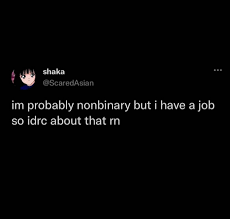
A couple of years later, you began to see people making videos about how they used to be trans, but now are not. Some laugh at their old self, their old pronouns. Some are wistfully nostalgic for themselves. There’s that joke- “I’m probably nonbinary but I have a job so idrc about that rn.” Being nonbinary was easy without the social, and financial pressure of participating in a binary society. But now, it’s seen as something most have grown out of. Being nonbinary, or nonconforming in any way just isn’t conducive to being a part of society.
The thing is, I don’t feel a huge amount of body dysphoria, and I never did. I felt mostly neutral in my body. For the most part, I don’t feel discomfort looking at my body relating to my gender or my primary sex characteristics, and most days I feel like my body represents me just fine. I even like it a lot of the time. There have been times where the emergence of certain secondary characteristics bothered me. As I’ve grown, my acceptance of my body tends to lag behind my body’s development. When I first got boobs, I did everything to hide them. But now I like them. Around 19-20 when my curves became more pronounced, I thought it was the end. But I’m okay with that too, now. On days I feel disgust or discomfort about my body, I don’t ever wish I was born a boy, or that my body was different. It’s more so a resentment towards my body for existing, that if it wasn’t for it, I could be whatever I want. It’s more existential than having to do with gender.
This is a pretty heated transmed debate, whether or not you can be trans without body dysphoria. This isn’t necessarily what this post is about, but it’s important to note, right? When I was a baby trans, I read the Gender Dysphoria Bible, an online resource that explains dysphoria and is a general guide for anyone questioning their gender. The bible explains that dysphoria is layered, and lays out different types of dysphoria: body, biochemical, social, societal, sexual, and presentational. Trans people often feel multiple types of dysphoria, but not necessarily all. Dysphoria can manifest in more ways than the “born in the wrong body” narrative or feeling anger when someone calls you a, “she.”
I am still nonbinary. I have “they/he” in my bio, I have the septum piercing, I have the trans flag in my room. But I stopped binding my chest most days, and I grew out my hair past my shoulders. More often than not, I present myself more traditionally feminine when I go out in public and I don’t ever correct people misgendering me unless it’s a friend. In the outside world, I stopped being a question mark and just exist as a girl for the most part. How most strangers treat women is how they treat me. How my family understands women’s roles in society is their expectations for me. Girls will ask me for tampons in the bathroom. Men volunteer to help me carry things at the store.
But among my friends, I’m other. I enjoy my pronouns, I enjoy hearing them from those I love, as a reminder and acknowledgement that I am wholly known as myself. Despite how I dress, or do my make-up, no– because of how I dress and do my makeup, my refusal to settle into a binary brings me wonder, joy, and liberation.
I refuse to go back on my transness because I distinctly remember the sense of freedom I felt when I realized I didn’t have to be a girl. That there were other ways to exist, to feel joy, to find acceptance and validity. Ways that didn’t involve looking pretty, performing for men, or being palatable in any way. Actually, it wasn’t until I lived as a transmasc person that I felt any real attraction for men. I discovered a way that I could like men for my own fulfillment of pleasure, connection, and companionship without existing for men. In fact, I felt like I couldn’t have a real attraction to anyone, because even my interactions with girls felt like they had predetermined parameters for what a relationship between two women could look like. I had very real experiences where I was talking to girls who liked me and felt like I was lying to them about who I was, without knowing why.
I felt freedom that I could present myself however I wanted, I stopped worrying about my acne, body hair, or body language. I felt like I was bad at being a girl for a very long time. I couldn’t bring myself to care about being pretty, even though I knew that being pretty came with privileges. There were only so many right ways to be a girl- the pretty girl, the smart girl, the cool girl, the doesn’t try so hard girl, athletic girl– they were all the same experience, really. But if being an acceptable girl was no longer an expectation I had for myself, it was not something I felt any pressure to live up to.
Any dysphoria I feel is mostly a sense of social otherness, detachment, and restriction within the confines of what is acceptable girlhood. I didn’t necessarily want to be a man, and if I had been assigned male at birth, I would feel equally, if not more, restricted by it.
There are TERFs that would argue that all these freedoms could be found for me without me ever having to stop being a woman, that with feminism, the pressure for women to act or be any particular way should and would be eliminated. But the thing is, I don’t want to be a liberated woman. I want liberation from being a woman. Or more accurately, I want liberation from having to be a woman.
What is being trans? Did I choose transness? People don’t like that notion, that someone would choose to be trans. Of course, transphobes already think this, and believe it is a choice made for attention, and to threaten their idea of normalcy and supremacy, their cishetero world order where everyone functions like them, and is as miserable in it as them. Even the tolerant liberal cisgender will not want to acknowledge this, if their acceptance of trans people is based in pity. And some trans people do not like this thinking, as it undermines their quest for validation from the cis world. But really, as long as we live in a cishetero world, we will not find true acceptance from it. The world as it is, no matter how much we introduce ourselves with our name and pronouns and one fact about us, in every facet, is built with cis-hetero-normality as its true north. Every trans person pursues transition, whatever that may mean for them, because it makes them happier than not being trans, for whatever reason.
I can sort of see and understand why TERFs think me being trans undermines their feminist ideals. What does female liberation mean if people just have an “easy way out” of being female? What does female liberation mean if anyone can decide for themselves that they are female? The “men bad, women good” narrative is easy to feed if your ideas of “man” and “woman” are fixed and strict. What gender-based oppression looks like is easy to understand if there is a singular view of what a female experience is. But I obviously don’t agree.
Living without cisgendered expectations made me find so much acceptance, and it’s the same acceptance that feminism fights for. We dream of a world where how we exist, form relationships, present ourselves, practice our passions, show up for each other, fuck, and love is not determined by our genitals, and our worth is not defined by what we do with them. It is a refusal of normalcy, the refusal of the narrowness of a life decided for us, and turning to each other for a life we decide for ourselves, no, create for ourselves. A life that is vast, limitless, and self-defined. Transness acknowledges that the systems of power we’ve made up are nebulous, and as we exist in them, we are nebulous. Our identities mean something, but are not lifelong sentences to a certain role, or life. That is not in opposition to feminist ideas, and is in fact, almost the same. Why should being trans for trans sake and being trans to escape expectations rooted in patriarchal power be mutually exclusive? It’s not. The oppressive power we seek liberation and refuge from is the same.
If I was not trans, but a woman, a liberated woman, and transness was not on the table, I would still live in a world where there are men and there are women, with no chance to escape that structure. That is not liberation to me.
A common source of invalidation for AFABs is the conflation of gender with the systemic oppression of women, particularly among non-medically-transitioning non-binary people. The message of “oh you just don’t want to be a woman because of how women are treated” is far too often heard, and it can deeply infest your subconscious to the point of self-doubt. But this doesn’t make much sense, because if you’re AFAB and not a woman, that makes you transgender, and, on average, society treats transgender folks worse than women. So transitioning to escape systemic oppression is a dumb concept (and I personally have never met a trans person who has done this).
Radical feminism’s messaging of abandoning female gender roles can also make parsing your own feelings harder. “Am I actually non-binary, or am I just a feminist?” “Am I actually a man, or am I just a very butch lesbian?”. For this, I encourage you to talk to cis woman feminists, especially lesbians. They’ll complain about systems of oppression and the patriarchy, but the problems are all external, and they want to be women. Even very butch lesbians want to be women, just in a different way from mainstream femininity.
Then you have the problem of people believing that to be non-binary is to be androgynous, and to be androgynous is to be less feminine. Feminine enbies are valid! It is okay if you do not want to remove your breasts. It is okay if you enjoy your curves. It is okay if you do not mind being called “she” and “her”. That does not make you any less transgender.
If you feel like you are not a binary woman, then you are not a binary woman. Cis women do not experience that detachment.
The Gender Dysphoria Bible
I also love that transness and queerness is a bit reactionary. I think being nonbinary wouldn’t be so fun if our world wasn’t so obsessed with binaries. I know that isn’t what people expect to hear from me, and you might not even like it. But part of the fun is the unchartedness of it, the discovery of self and of life. How I understand myself and my transness has been inextricably shaped by the binary world I exist within. I’m not sure if I would have it differently, or if I can even imagine differently. What would it mean to be trans in a world where gender does not exist or means nothing? I suppose that is the fear that conservatives have, too. So much of my understanding of myself is rooted in refusal. I’m a little immature that way. But I’m not scared. Gender will always mean something. Transgender people love gender. Why would a trans woman be a woman if she didn’t love womanhood? Don’t trans men love manhood? I personally love gender. I love to subvert gender, toy with it, exist between binaries, jump back and forth, dissect it, and celebrate it. I turn and face every complex situation my gender has put me in with excitement and awe.
In any case, saying that I identify the way I do to avoid how women are poorly treated is a little dumb because, hello… I am still treated as a woman by society. I still walk around looking like a woman, shaped like a woman, and to anyone except those I’ve entrusted with my identity, I am a woman. Because of this, sometimes I wonder what difference me being nonbinary makes in my life and my search for freedom. But the answer comes to me as naturally and easily as being trans does. The difference my transness makes in my life is personal, it’s political, it’s everything. It shapes my relationship with myself, my body, my joy, my pleasure, my heartache. It shapes my relationships with my partner, my close friends, my family, my culture. It shapes my relationship with the world, how I perceive it and how it perceives me. It shapes my relationship with my community, how I empathize with others’ experiences with otherness, and how I find acceptance and love from others.
Consider That Transition Is Less About Discovering A Single Metaphysical Truth And More About Doing What Makes You Happy
… it’s worth keeping in mind that you are not a puzzle to be solved. You do not have to perform an exact taxonomic classification of your own gender. You’re just a human with your own complex set of needs, desires, dreams, goals, fears, triggers, and a whole mess of everything else. You are a contradictory, complex, illogical being who contains vast multitudes.
This is kind of scary, but hopefully it’s also somewhat freeing. There’s no “proper” timeline to your transition. No list of things that you absolutely have to do. You can keep your name, or change it. You can get gender confirmation surgery, or you can keep what you’ve got. You can wear dresses every day, or you can leave them all for me. Some trans ladies have been dressing like women since they were old enough to buy clothes, but I didn’t once wear a full femme outfit until I was already three months into HRT. There are no rules. They were all made up by people who have been dead for hundreds of years.
The Gender Dysphoria Bible
I’ve learned a lot about transness and feminism from trans women. The Gender Dysphoria Bible that was my guiding light when I first came out was written primarily by trans women and their combined experiences with dysphoria, discovery, and transmisogyny. As I went from dressing and looking more masculine to looking more feminine as a nonbinary person, I felt a lot of guilt, despite enjoying it. But when I look to transfeminine people, how they find and create joy and newness through feminine expression, I am reminded that choosing to look and be outwardly feminine is also a queer choice, and a brave one. For as long as I am happy looking like a girl outwardly, I will do so and feel trans as I do it. And I still have days where I prefer to bind, put on pants, and feel masculine.
I don’t feel like I’m not a girl. I’m just also not not a boy. Why should I have to choose between them when there is an infinite amount of experiences and wisdom to gain from both, between, and outside of them? Wisdom, freedom, and love, too.